DANIELLA BIANCHI
JANUARY 4TH, 2021
Does Gender Equality Exist in Australia?
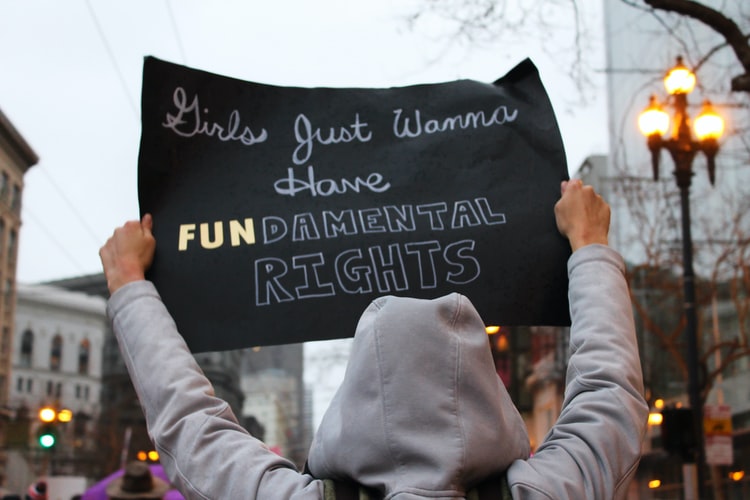
As a girl, like many of my generation, I have learnt to accept and tolerate behaviours that are unfair. I have been harassed on the train going home too many times and honked at as I was running (even in COVID times). When I have made a complaint, people have told me that I should be dressing more modestly, which doesn't fix anything. If girls who like girls can control themselves, maybe what we are wearing isn't the issue? Women don't owe people modesty to be respected and taken seriously. I shouldn't have to accept it. As a society we shouldn't have to.
Men are not the ones to blame for this.
Gender equality means the equal treatment of all genders in society. It means everyone is entitled to the same rights, opportunities, responsibilities and protection. Gender equality affects everybody’s experience in Australia, you may have just been conditioned to not notice. The UN says gender equality is, “essential to achieve peaceful societies, with full human potential and sustainable development.” Females make up half the population and thus possess half the potential of humanity but gender inequality stagnates social progression. Discrimination and inequality still experienced by women limits the choices and opportunities available to them. Recognising the value in the skills and contributions of women will allow us to progress as a global community and could result in a boosted economy and better quality of life.
Not only is gender equality a fundamental human right but an essential foundation for a peaceful, prosperous and sustainable world. Although there has been progress over the last decades including the rise in numbers of females attending school, less coercion of girls into early marriage, more women serving in positions of leadership and reforming of laws to advance gender equality, it would be extremely incorrect to assume gender equality exists, even in our modern Australian society. Many challenges still remain: social norms and discriminatory laws remain pervasive and women continue to be underrepresented in many levels.
I was shocked to find out that Australia failed to make the top 40 in global rankings for gender equality. World Economic Forum’s Global Gender Gap Report 2020 uncovered that there is still a long way to go to achieve worldwide gender parity and this stuns me. Australia ranks 49th on the economic participation gap (measuring wages, employment and workforce representation), number 1 for the education gap (gender parity for access to literacy and numeracy skills) and ranked 57th for representation of women in politics. Alone, these statistics make me feel that things are looking up. Yet, when comparing the Australia of 2020 with the Australia of 2006 which had ranked 15 on the global index not 44, they don't make me feel Australia is heading in the right direction at all. The current rate of efforts being made is very slow and worrying.
 This segregated distribution of men and women across jobs affects the gender wage gap. This is also not just a matter of choice in occupations. Many women are forced out of non-traditional occupations by hostile work environments, which is something I fear I may face entering a male-dominated engineering world. For example, 63 % of women working in STEM (science, technology, engineering, and mathematics) experience sexual harassment (Hewlett et al. 2008). This is a crazy high percentage. Over time, 52 % of women in these fields quit their jobs, half of whom end up leaving these fields altogether (Hewlett et al. 2008) which is sad and shouldn't be the case.
The gender wage gap is calculated often, by dividing the women’s earnings by men’s earnings. Presently, the gender pay gap in Australia is 14% meaning for every dollar a man makes, a woman makes about 86 cents. Men’s average weekly full-time earnings across all occupations was $ 1 812.00 compared to women’s average weekly full-time earnings across all occupations being $1 558.40 (Commonwealth Government of Australia, 2018). Put on top of this that women are retiring with much less superannuation than men (ABS, 2020). If we were all given the same opportunities, a gap in both regards would be negligible.
Typically, women have less work experience than men which contributes to the gender wage gap. Yet to use this statement to support the idea that discrimination doesn’t play a role would be incorrect, because the lack of experience itself is a consequence of social expectations and norms that disadvantage women in the working field. On average, women are more likely to temporarily leave the labour force, leaving them with less work experience (often to raise children or care for an older relative). A study conducted with workers having masters of business administration (MBA) revealed that only 4 % of men experienced a career interruption of 6 months or more compared with 9% of women in the year after receiving the degree (Goldin, 2014). Looking further out, in the 10 to 16 years following graduation with an MBA, 32% of women had experienced a career interruption compared with 10 % of men (Bertrand, Goldin, and Katz 2009). These are major differences in percentages that led us to consider what is really happening.
Observe that when you ask parents if they want to raise their sons and daughters differently most will say no, yet if you then ask about whether parents feel comfortable with their son playing with dolls, they are often not so relaxed. Such stereotypes impact and influence the future of the children’s thinking and interests. Everything from what toys children play with to what subjects they choose at school have these life-long impacts on career choices. Stereotypes discouraging boys from playing with dolls and expressing their emotions moves them away from jobs like nursing and childcare. Similarly, with girls discouraged from playing with “masculine” toys like building blocks, means they miss out on developing spatial skills linked to mathematics. For me, I was just lucky that I had such a strong personality as a child and my parents let me play how I wanted (within reason).
Moreover, the outdated dress codes that dictate what a girl can and can’t wear as she received an education should be overturned. Why do dress codes make girls cover up so boys never have to learn self control? School is a place of learning and comfort and should be concerned with the quality of education rather than the length of a girl’s dress. So many of my friends in highschool received detentions because their skirts were higher than MID CALF! Yet where were the penalties for putting each other down based on our physical appearances?
Girls are taught to worry about unwanted attention and are concerned about the everyday pressure to look “just right” against a picture-perfect Instagram world. A basic right is to feel safe in our workplaces, educational institutions, public places and homes. However, for many women, they have a story to tell about experiencing everyday sexism and harassment and often is an everyday reality. Ultimately, many women just accept, tolerate and expect that it’s the price they have to pay and I used to belong to this group. While the Sex Discrimination Act 1984 (Cth) provides a legal avenue for redress, there remains concern about the ability of individual complaints alone to deliver broader cultural change. Ending discrimination, harassment and violence against women is critical for women to be able to equally contribute to and benefit from economic, social, cultural and political life. I believe the way forward is by starting this discussion.
Australia’s paltry gender equality record arises from a culture of oppression embedded into the societal norms. “We still have attitudes and work place practices that are a direct result of the attitudes and practices of the fifties and sixties,” Avril Henry, internationally renowned keynote speaker, author and provocateur, says. The role of women has been historically devalued. For example, until 1966, a married woman had to give up her career because she had a new job - being a wife and mother. Nowadays we use language inappropriately which immortalise the existing stereotypes creating an illusion that women aren’t capable. Take for example, the fact that women in positions of power are constantly critiqued on their clothing or referred to as “mother of triplets”. Take for example, Sarah Hanson-Young, the youngest woman to have a seat in Australia’s senate in 2007 (at 25). She has explained how she often experienced a backdrop of mutterings from male opponents "about my dress, my body, and my supposed sex life". Looking at another example, Natasha Stott Despoja joined parliament in 1995 at age 26, when women made up just 14% of the room. In her 13 years as a senator, sexism was “endemic” in politics she says. "It ranged from male senators saying to me 'you really should wear skirts' to another senator referring to me only as 'mother' once I had children," she told the BBC.
The rate of progress towards achieving gender parity in both the developing world and Australia is agonisingly slow and bad news for future generations. Changing attitudes is key to achieving long-term gender equality. Overall, there is so many more areas that haven’t been touched upon that warrants more concern and the need for positive transformation. In saying this, it is important that we ourselves become aware of what we can do to support one another.
• Australian women account for 70% of primary unpaid carers for children (Workplace Gender Equality Agency, 2016)
• More than half the women over the age of 18 have experienced sexual violence (ABS, 2017)
• On average, Australian women have to work an extra 56 days a year to earn the same pay as men for doing the same work. (Workplace Gender Equality Agency, 2018)
• 1 in 5 women aged between 15 and 49 report experiencing physical or sexual violence by an intimate partner within a 12-month period (UN, 2020).
Men are not the ones to blame for this.
The go is that
our society is. These outdated attitudes and behaviours need to get in shape and change. Gender equality means the equal treatment of all genders in society. It means everyone is entitled to the same rights, opportunities, responsibilities and protection. Gender equality affects everybody’s experience in Australia, you may have just been conditioned to not notice. The UN says gender equality is, “essential to achieve peaceful societies, with full human potential and sustainable development.” Females make up half the population and thus possess half the potential of humanity but gender inequality stagnates social progression. Discrimination and inequality still experienced by women limits the choices and opportunities available to them. Recognising the value in the skills and contributions of women will allow us to progress as a global community and could result in a boosted economy and better quality of life.
Not only is gender equality a fundamental human right but an essential foundation for a peaceful, prosperous and sustainable world. Although there has been progress over the last decades including the rise in numbers of females attending school, less coercion of girls into early marriage, more women serving in positions of leadership and reforming of laws to advance gender equality, it would be extremely incorrect to assume gender equality exists, even in our modern Australian society. Many challenges still remain: social norms and discriminatory laws remain pervasive and women continue to be underrepresented in many levels.
I was shocked to find out that Australia failed to make the top 40 in global rankings for gender equality. World Economic Forum’s Global Gender Gap Report 2020 uncovered that there is still a long way to go to achieve worldwide gender parity and this stuns me. Australia ranks 49th on the economic participation gap (measuring wages, employment and workforce representation), number 1 for the education gap (gender parity for access to literacy and numeracy skills) and ranked 57th for representation of women in politics. Alone, these statistics make me feel that things are looking up. Yet, when comparing the Australia of 2020 with the Australia of 2006 which had ranked 15 on the global index not 44, they don't make me feel Australia is heading in the right direction at all. The current rate of efforts being made is very slow and worrying.
Workforce
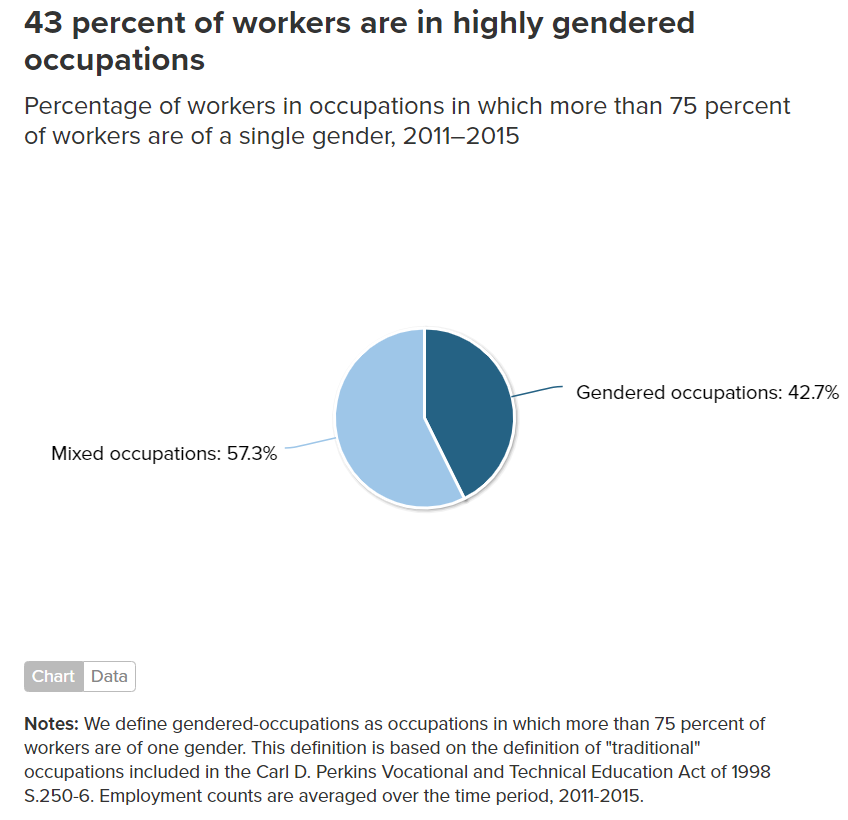
The Australian workforce is greatly separated by gender and female-dominated industries (seen as aged care, child care and health and community services) which have been undervalued historically. Women in Australia are over-represented as part-time workers in low paid industries (Australian Human Rights Commission, 2013), which doesn't sit well with me. The image below is taken from a 2016 EPI report.
This segregated distribution of men and women across jobs affects the gender wage gap. This is also not just a matter of choice in occupations. Many women are forced out of non-traditional occupations by hostile work environments, which is something I fear I may face entering a male-dominated engineering world. For example, 63 % of women working in STEM (science, technology, engineering, and mathematics) experience sexual harassment (Hewlett et al. 2008). This is a crazy high percentage. Over time, 52 % of women in these fields quit their jobs, half of whom end up leaving these fields altogether (Hewlett et al. 2008) which is sad and shouldn't be the case.The gender wage gap is calculated often, by dividing the women’s earnings by men’s earnings. Presently, the gender pay gap in Australia is 14% meaning for every dollar a man makes, a woman makes about 86 cents. Men’s average weekly full-time earnings across all occupations was $ 1 812.00 compared to women’s average weekly full-time earnings across all occupations being $1 558.40 (Commonwealth Government of Australia, 2018). Put on top of this that women are retiring with much less superannuation than men (ABS, 2020). If we were all given the same opportunities, a gap in both regards would be negligible.
Typically, women have less work experience than men which contributes to the gender wage gap. Yet to use this statement to support the idea that discrimination doesn’t play a role would be incorrect, because the lack of experience itself is a consequence of social expectations and norms that disadvantage women in the working field. On average, women are more likely to temporarily leave the labour force, leaving them with less work experience (often to raise children or care for an older relative). A study conducted with workers having masters of business administration (MBA) revealed that only 4 % of men experienced a career interruption of 6 months or more compared with 9% of women in the year after receiving the degree (Goldin, 2014). Looking further out, in the 10 to 16 years following graduation with an MBA, 32% of women had experienced a career interruption compared with 10 % of men (Bertrand, Goldin, and Katz 2009). These are major differences in percentages that led us to consider what is really happening.
Social Domain
Social and labour policies can only go so far in achieving gender equality if stereotypes continue to limit women's (and men's) choices. One must critically examine the messages being sent to daughters and sons at home about domestic responsibility. It is common that women are viewed as the main caretakers of housework and child rearing with men positioned as occasional helpers which is doing a disservice to both genders. When I go to my Nonni (grandparent's) house for Sunday lunch, my Mother is ushered into the kitchen, while my Father is led into the dining room to relax. AND this can't be a matter of her cooking skills because inherently, Italians believe Italians are the best cooks, and if my Italian Father was instead my Italian Mother, he would be led into the kitchen instead of my Australian Mother. But because she is a female, the expectation that she is the one in the kitchen remains.Observe that when you ask parents if they want to raise their sons and daughters differently most will say no, yet if you then ask about whether parents feel comfortable with their son playing with dolls, they are often not so relaxed. Such stereotypes impact and influence the future of the children’s thinking and interests. Everything from what toys children play with to what subjects they choose at school have these life-long impacts on career choices. Stereotypes discouraging boys from playing with dolls and expressing their emotions moves them away from jobs like nursing and childcare. Similarly, with girls discouraged from playing with “masculine” toys like building blocks, means they miss out on developing spatial skills linked to mathematics. For me, I was just lucky that I had such a strong personality as a child and my parents let me play how I wanted (within reason).
Moreover, the outdated dress codes that dictate what a girl can and can’t wear as she received an education should be overturned. Why do dress codes make girls cover up so boys never have to learn self control? School is a place of learning and comfort and should be concerned with the quality of education rather than the length of a girl’s dress. So many of my friends in highschool received detentions because their skirts were higher than MID CALF! Yet where were the penalties for putting each other down based on our physical appearances?
Girls are taught to worry about unwanted attention and are concerned about the everyday pressure to look “just right” against a picture-perfect Instagram world. A basic right is to feel safe in our workplaces, educational institutions, public places and homes. However, for many women, they have a story to tell about experiencing everyday sexism and harassment and often is an everyday reality. Ultimately, many women just accept, tolerate and expect that it’s the price they have to pay and I used to belong to this group. While the Sex Discrimination Act 1984 (Cth) provides a legal avenue for redress, there remains concern about the ability of individual complaints alone to deliver broader cultural change. Ending discrimination, harassment and violence against women is critical for women to be able to equally contribute to and benefit from economic, social, cultural and political life. I believe the way forward is by starting this discussion.
Australia’s paltry gender equality record arises from a culture of oppression embedded into the societal norms. “We still have attitudes and work place practices that are a direct result of the attitudes and practices of the fifties and sixties,” Avril Henry, internationally renowned keynote speaker, author and provocateur, says. The role of women has been historically devalued. For example, until 1966, a married woman had to give up her career because she had a new job - being a wife and mother. Nowadays we use language inappropriately which immortalise the existing stereotypes creating an illusion that women aren’t capable. Take for example, the fact that women in positions of power are constantly critiqued on their clothing or referred to as “mother of triplets”. Take for example, Sarah Hanson-Young, the youngest woman to have a seat in Australia’s senate in 2007 (at 25). She has explained how she often experienced a backdrop of mutterings from male opponents "about my dress, my body, and my supposed sex life". Looking at another example, Natasha Stott Despoja joined parliament in 1995 at age 26, when women made up just 14% of the room. In her 13 years as a senator, sexism was “endemic” in politics she says. "It ranged from male senators saying to me 'you really should wear skirts' to another senator referring to me only as 'mother' once I had children," she told the BBC.
The rate of progress towards achieving gender parity in both the developing world and Australia is agonisingly slow and bad news for future generations. Changing attitudes is key to achieving long-term gender equality. Overall, there is so many more areas that haven’t been touched upon that warrants more concern and the need for positive transformation. In saying this, it is important that we ourselves become aware of what we can do to support one another.
Shocking Facts
• Women spend almost twice as much time compared to men completing unpaid care work (Workplace Gender Equality Agency, 2016)• Australian women account for 70% of primary unpaid carers for children (Workplace Gender Equality Agency, 2016)
• More than half the women over the age of 18 have experienced sexual violence (ABS, 2017)
• On average, Australian women have to work an extra 56 days a year to earn the same pay as men for doing the same work. (Workplace Gender Equality Agency, 2018)
• 1 in 5 women aged between 15 and 49 report experiencing physical or sexual violence by an intimate partner within a 12-month period (UN, 2020).
EDIT
One of my readers, Steve Kraynov, (also with his own blog) wrote to me about the social trends on paid and unpaid work.
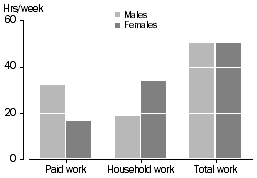
Despite women assuming a greater role in the paid workplace, the hours spent doing household work did not decrease based off a 2006 Time Use Survey.
In reality, it was found that women spent the same amount of time on household work in 2006 as they had in 1992.
Even the latest survey by the Bureau of Statistics on the household impacts of COVID 19 in 2020 demonstrates that although for both sexes the amount of
time spent doing unpaid work has increased, it is the women who continue to do the majority of the domestic duties. For me, this doesn't strike me as just and further demonstrates how WE need to work together to combat these big differences.
It stated that "women were almost twice as likely as men to have spent five hours or more on unpaid
indoor housework (54% compared with 28%)" read more on this gendered occupations study..